
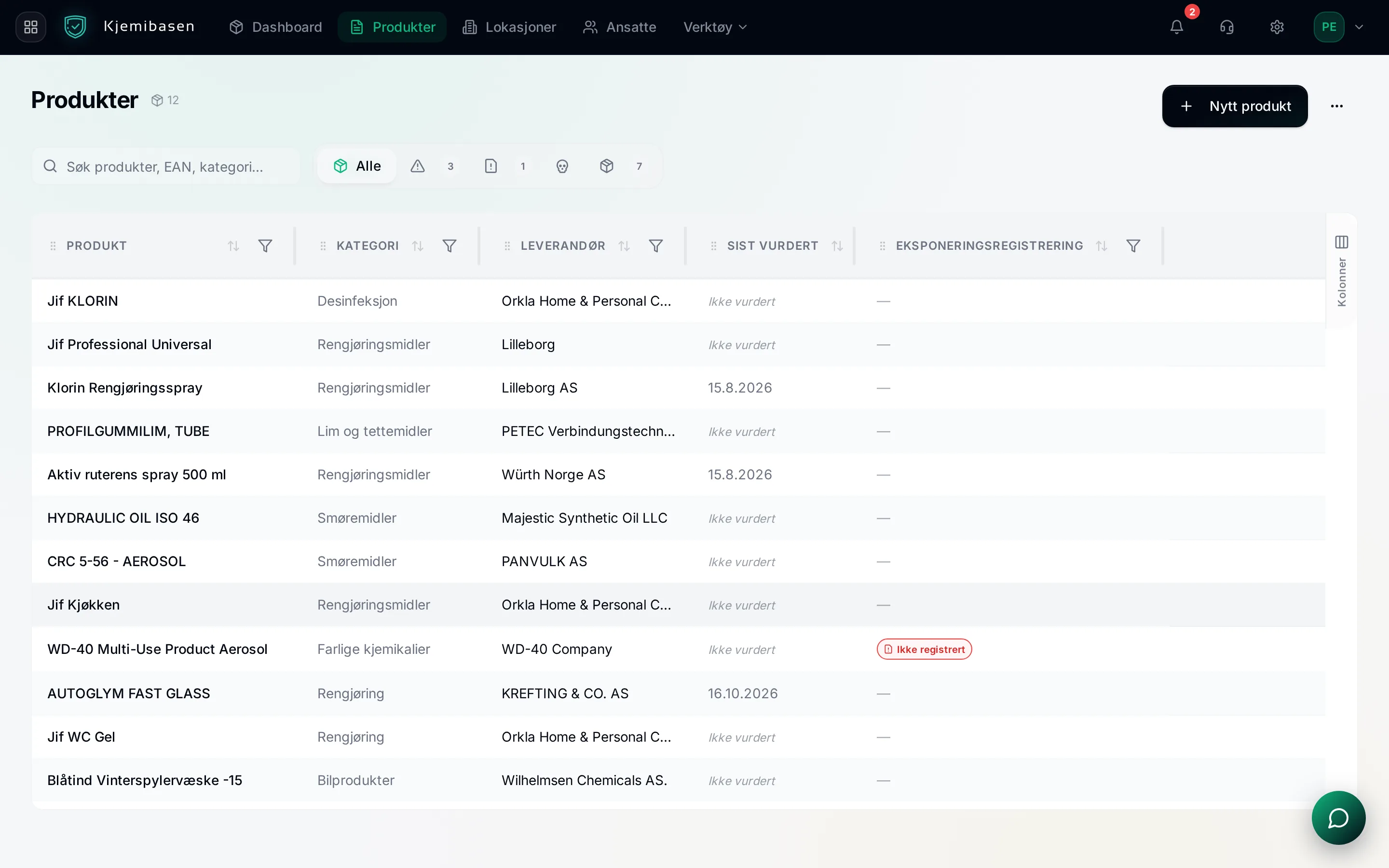
Occupational safety regulators require every workplace using hazardous substances to maintain a complete chemical register. The rules are concrete, and they are among the first items checked during workplace inspections.
In short, employers must maintain:
- A complete inventory of hazardous products used or stored on site
- An up-to-date Safety Data Sheet in the appropriate language for each product
- A documented risk assessment covering practical workplace usage
- Instant access to safety information for anyone potentially exposed—where work happens
- Documented worker training on chemical risks
- Clear routines to keep the register current over time
Below, we review each requirement in detail, highlighting where facilities most frequently run into audit findings.
Regulatory background
General duty of care
Occupational safety legislation places a duty of care on employers to safeguard worker health against biological and chemical hazards, assess exposure risks, and communicate controls clearly.
Chemical safety and workplace exposure regulations
Regulations governing chemical agents require employers to maintain an inventory of hazardous substances, specify required information, and ensure accessibility for employees and safety representatives regardless of business size.
Workplace exposure limits
Workplace exposure limits (WEL / OEL) cap permissible atmospheric concentrations of hazardous substances. Chemical records must provide enough detail to assess real-world exposure against these thresholds.
REACH, CLP, and GHS standards
Chemical classification and labelling follow international standards: GHS globally, CLP in the European Union, and HazCom in the United States. These frameworks dictate the hazard pictograms, H-statements, and precautionary measures displayed on labels and data sheets.
What your chemical register must contain
1. Safety Data Sheets (SDS) for every hazardous product
The SDS is the foundation of your register. It follows a standardised 16-section structure:
Identification of the substance/mixture and supplier
Hazard identification (classification and labelling)
Composition / information on ingredients
First aid measures
Fire-fighting measures
Accidental release measures
Handling and storage
Exposure controls and personal protection
Physical and chemical properties
Stability and reactivity
Toxicological information
Ecological information
Disposal considerations
Transport information
Regulatory information
Other information (revision dates)
Sections 4, 7, and 8 are the most critical in daily operations: first aid, storage segregation, and PPE selection. Read more in our guide on how to read a safety data sheet.
How SDSLibrary simplifies this: Data sheets are sourced automatically from a database of over 17 million documents. If a sheet is missing, our team tracks it down so you never have to chase suppliers manually.
2. Risk assessment for actual workplace use
An SDS describes a product generally. Your risk assessment evaluates how *your team* handles it: who is exposed, how often, for how long, in which rooms, and under what ventilation conditions.
A compliant risk assessment identifies the hazard (from the SDS), actual exposure, overall risk level, implemented controls, and next review date. See our step-by-step guide to chemical risk assessments.
3. Clear local information where work takes place
Data sheets must be accessible in a language your team understands and located right where products are handled—not locked in an administrative office across the facility.
How SDSLibrary solves this: Each storage location or cabinet gets a dedicated QR poster. Scanning it with any smartphone camera displays all products stored there, with instant full-screen SDS viewing. No app download or login required for staff.
Common inspection non-conformances
Audits routinely highlight the same issues across industrial and commercial sites:
- Missing products from the register: Frequently maintenance sprays, adhesives, floor cleaners, or legacy containers stored in back rooms.
- Outdated data sheets: The manufacturer issued a revised SDS, but the workplace records were never updated.
- Inaccessible documentation: SDS files are saved inside internal software accessible only by a single manager.
- No recorded risk assessments: Data sheets exist, but no documentation explains how staff safely use the products.
- Undocumented training: Staff received verbal safety advice, but no signed records prove compliance.
- No ownership: The register was compiled years ago and neglected ever since.
For audit preparation, review our checklist on preparing your chemical register for an inspection.
What happens when inspectors identify issues?
Improvement notices are the most common outcome. Organisations receive a clear timeline to resolve identified gaps.
Fines or penalties may follow if corrective actions are not completed within the assigned timeframe.
Stop-work orders apply in cases of imminent danger to worker health and safety.
Proactive chemical management prevents the stress of emergency multi-week remediation projects before scheduled audits.
Six steps to full compliance
1. Audit your site. Walk through workshops, toolrooms, vans, and storage closets. List everything with a hazard label.
2. Sourced updated SDSs. Ensure current revisions are in place for each item.
3. Assess practical risk. Document how each chemical is used and what safeguards are required.
4. Implement control measures. Upgrade ventilation, enforce appropriate PPE, or replace hazardous products. See our guide on chemical substitution.
5. Conduct and record training. Train staff on reading chemical labels and responding to spills, keeping signed logs.
6. Establish ongoing routines. Add new products before ordering, run an annual audit, and assign clear responsibility.
How SDSLibrary helps
The compliance rules apply no matter how you track chemicals. The difference lies in the effort required.
- Storage QR posters: Scan with a phone camera to see local products instantly. No apps or logins needed for workers.
- Automated SDS retrieval: Enter the product name, and we source the data sheet.
- Revision tracking: The system flags when documentation needs an update.
- Audit-ready reports: Export full compliance reports with one click.
- Dedicated support: Built specifically to meet international chemical safety frameworks.
Learn more about our chemical register solution, or read the complete digital chemical register guide.
Summary
Meeting chemical inventory requirements comes down to a few core habits: complete product visibility, current SDSs, documented risk assessments, point-of-use access, and regular reviews. With the right platform, compliance becomes automatic.
Frequently asked questions
Do small businesses need a chemical register?
Yes. The obligation stems from using hazardous substances, not team headcount. A small workshop using degreasers, glues, and lubricants has the same fundamental duty to track hazards and protect workers as a large plant.
Is a paper binder sufficient for compliance?
While paper binders are technically allowed in some jurisdictions, they frequently fail compliance inspections due to poor accessibility or outdated sheets. Documents must be accessible where the work takes place—a locked office binder during night shifts does not meet compliance standards.
How recent must a Safety Data Sheet be?
There is no fixed expiration date, but you must hold the current version issued by the manufacturer. If a substance is reclassified or regulations change, an updated version is required. An annual review of your library is recommended.
What language must the SDS be in?
SDSs must be in the official local language of the country where the product is supplied and used. If workers speak other languages, hazard communication must also be understandable to them.
Who is legally responsible for the chemical inventory?
The employer carries ultimate legal responsibility. Daily management can be delegated to an EHS manager or facility lead, but accountability remains with company leadership.
What happens during a failed chemical safety inspection?
Inspectors typically issue an improvement notice with a binding deadline. Failure to comply can lead to fines, and imminent hazards can result in immediate stop-work orders.
Does the register have to be digital?
Most regulations do not mandate digital formats specifically. However, digital systems make meeting accessibility, revision tracking, and multi-location requirements far easier to prove during audits.
Are cleaning chemicals and lubricants included?
Yes, provided they carry hazard classifications. Facilities frequently overlook everyday cleaning agents, oils, and aerosols, which is one of the most common findings during inspections.