
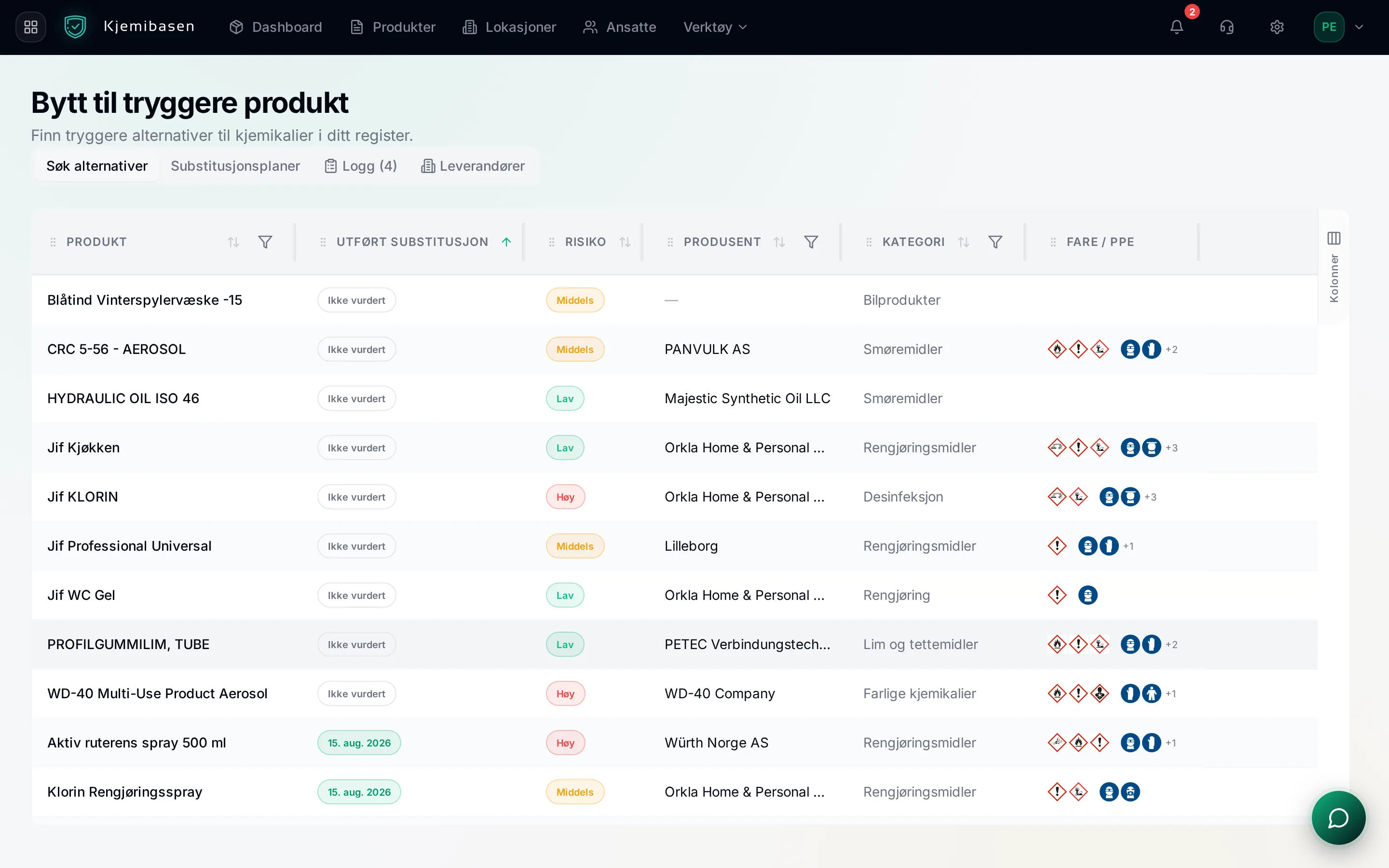
Chemical substitution is one of the most effective principles in industrial hygiene—and an area regulators increasingly inspect. Many facilities use hazardous products without realizing that modern, safer alternatives are readily available.
Here is an overview of regulatory expectations, assessment steps, and how to track reviews effortlessly.
What is chemical substitution?
Substitution means replacing a hazardous chemical or risky process with an alternative that carries lower risk. Typical examples include:
- Switching from solvent-based degreasers to water-based cleaners.
- Moving from aerosol spray applications to brush or paste application to reduce airborne mist.
- Replacing products containing CMR substances with non-classified formulations.
Substitution sits at the top of the hierarchy of controls immediately below total elimination. It is vastly more protective than PPE because it removes or diminishes the hazard at the source.
Regulatory foundation
Occupational health frameworks and chemical regulations establish clear substitution principles:
- Employers must examine whether safer chemicals or processes exist before relying on protective equipment.
- For Carcinogenic, Mutagenic, and Reprotoxic substances (CMRs), substitution is prioritized whenever technically possible.
- Substitution reviews must be documented in writing—even when the outcome is to keep using the existing product with additional controls.
Step-by-step substitution assessment
1. Identify priority candidates
Review your chemical inventory and flag substances carrying:
- CMR classifications (H340, H341, H350, H351, H360, H361)
- Sensitising classifications (H317, H334)
- Volatile organic solvents with elevated risk ratings
- Substances on regulatory candidate lists for authorization
2. Define the product's function
Identify the precise operational task. Is the product used for precision degreasing, high-adhesion bonding, surface coating, or general cleaning?
3. Source potential alternatives
Consult chemical suppliers, evaluate industry benchmarks, and examine alternative application methods that eliminate the need for harsh chemicals.
4. Compare comprehensive profiles
Evaluate human health hazards, fire safety, environmental impact, operational performance, and overall costs. Ensure you do not solve one hazard while introducing another.
5. Document the final decision
Record the options assessed, final conclusion, and justification. If retaining the product, outline the protective controls in place.
6. Update safety records
Update your chemical register, risk assessments, and staff training records.
Substitution assessment record example
| Field | Detail |
|---|---|
| Current Product | Solvent-based contact adhesive |
| Hazards | H225, H336, H361 (suspected reproductive hazard) |
| Operational Use | Assembly line bonding, daily 30 min |
| Alternative Assessed | Water-based contact adhesive |
| Conclusion | Substitute approved. Trial demonstrated required bonding strength. |
| Date & Sign-off | Documented date and EHS manager signature |
Why substitution documentation is often missing
- Facilities lack a unified view of which stored chemicals contain CMR substances.
- Auditing individual SDS documents manually requires substantial time.
- Assessments happen informally in conversations without written records.
- When an SDS classification updates, managers are rarely notified.
How SDSLibrary automates substitution workflows
SDSLibrary handles the administrative tracking:
- Automatic flagging of high-hazard substances: The system analyses H-statements directly from data sheets to highlight CMRs, sensitisers, and high-risk chemicals.
- Centralised review logs: Record your findings, justifications, and review dates directly on the product's digital file.
- Revision alerts: If a manufacturer updates an SDS with a new hazard classification, the product is re-flagged automatically.
- Audit-ready reporting: Export consolidated substitution reports for management reviews and inspector requests.
Summary
Chemical substitution reduces workplace risks at the source. The challenge lies in identifying candidates across large inventories and maintaining up-to-date documentation. Modern digital tools streamline this process from detection to final sign-off.
Frequently asked questions
What is chemical substitution?
Chemical substitution is the process of replacing hazardous substances or processes with less dangerous alternatives. It is a fundamental legal requirement under occupational safety and chemical regulations whenever technically and economically feasible.
Must substitution assessments be documented?
Yes. Regulators expect written documentation of substitution reviews—including instances where you conclude that replacement is not currently feasible, along with the technical justification.
Which chemicals should be evaluated first?
Carcinogens, mutagens, and reprotoxic substances (CMRs), respiratory sensitisers, persistent organic pollutants, and substances on REACH or national candidate lists. CMRs face the strictest regulatory scrutiny.
Can substitution tracking be automated?
Yes. SDSLibrary flags products requiring substitution review based on SDS hazard statements and tracks the documented evaluations directly on each chemical profile.
What if no viable alternative exists?
Document that the review was conducted, state why the product is retained, and specify the engineering and PPE controls used to manage risk. Revisit the evaluation during your annual review.